Hardshell Rooftop Tents: Complete Buyer Guide
Disclosure: BatteryTrail is reader-supported. If you buy through links on this page, we may earn a commission at no extra cost to you.
Hardshell tents are rooftop tents with a rigid top and bottom shell that lift apart on gas struts. Setup takes about 60 seconds.
A softshell takes 5 to 10 minutes to unzip, unfold and prop on its ladder, according to JACO's buyer's guide. That gap is the whole decision in one line.
The guide below covers the shell types, how to size a tent against your roof and crossbar limits, and the brands worth shortlisting.
What Is a Hardshell Rooftop Tent? (Definition and How It Works)
Yes, hard shell tents exist. IKamper, Roofnest, Thule and The Bush Company all sell them, and the category is well established. A hardshell rooftop tent has a rigid top and bottom shell that lift apart on gas struts. A soft canvas tent folds open instead.
How the mechanism works
The sequence is short. As JACO Superior Products puts it in its buyer's guide: "Setup is genuinely 60 seconds, release two latches, push up, done." Gas struts take the weight of the shell, so you aren't wrestling fabric and poles in the dark.
Timing varies by shell design. The Bush Company lists clamshell models as "up in about 30 seconds." Its double-action pop-up style lifts both ends and is up in about 60 seconds.
Why the shell matters
The shell is the structure. It's not just a lid. The Bush Company builds its tents with aluminium shells on a B-Tech® Alloy frame, dual-layer blackout canvas and automotive-grade seals, which it says keep the tent dust free and watertight. That same company notes its clamshell opens "with standard bedding, sheets and sleeping bags stored inside," so you pack up without stripping the bed each morning.
If you want a cheaper tent that folds instead of lifting, the hardshell argument mostly disappears. The shell is what buys you the 30 to 60 second setup and the sealed, dust-resistant box.
Types of Hardshell Tents: Clamshell vs Double-Action Pop-Up
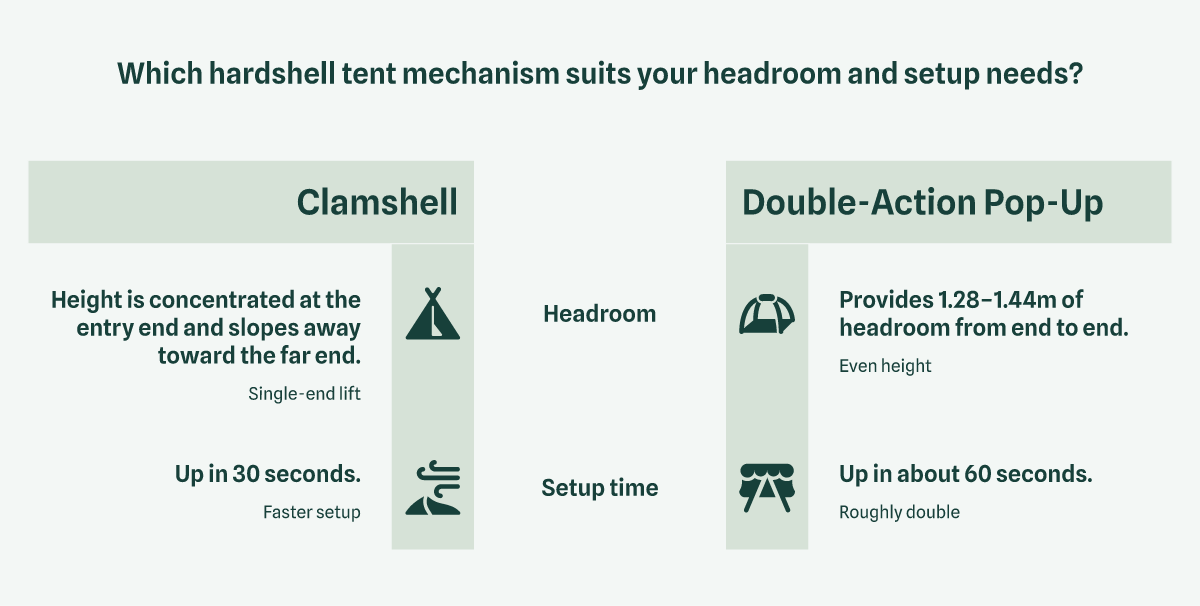
Hardshell tents split into two shell mechanisms. The one you pick decides how much headroom you get and where it sits.
Clamshell
A clamshell has a single hinge at one end. The shell lifts at the entry end only, which concentrates the height where you climb in. The Bush Company describes its all-round clamshell as "up in 30 seconds, 1.7m of headroom at the entry end, room for full bedding inside, built-in 12V and USB power, and a roof rated to 200kg dynamic when closed."
A 200kg dynamic roof rating matters if you want to mount gear or a second tent up top. The trade-off is headroom that slopes away toward the far end.
Double-Action Pop-Up
A double-action roof lifts at both ends. The Bush Company describes it as "both ends lift, for 1.28–1.44m of headroom from end to end, and they're up in about 60 seconds." One model adds "six doors and windows, and 190mm of bedding space when closed."
That even headroom costs you roughly double the setup time. If you pack bedding inside and leave it there, the trade is usually worth it. If you set up and strike camp daily, I would take the clamshell's 30 seconds.
Fold-Out Hybrid
OutdoorGearLab notes the iKamper Skycamp 3.0 Mini "employs a hardshell fold-out design." Pure Hiker calls the Skycamp 3.0 "a flagship family rooftop tent that redefines what hardshell camping can offer."
Quick Comparison
If neither fits your vehicle's roof load rating, a softshell is the honest answer, not a heavier shell.
How to Choose a Hardshell Tent
Start with three numbers from your owner's manual
Find your vehicle's dynamic roof load rating, your crossbar rating, and your total payload. All three cap what you can carry. Territory Supply puts the crossbar problem plainly: "even if your car holds 1,000 pounds, you can't load that much if your crossbars are only rated to 500 pounds." The lowest number wins, so size your tent against the weakest link, not the roof.
Do the weight math before you shop
JACO's buyer's guide states that "a typical rooftop tent weighs 100–200 lbs empty, and two adults plus bedding adds another 350–450 lbs." Real models sit inside that empty range. Say your tent is 176 lbs and two adults plus bedding add 400 lbs. That is 576 lbs on the roof before a single duffel. If your dynamic rating is lower, you need a lighter tent, not a stronger rack.
Check garage clearance
A closed hardshell sits 6"–10" tall on top of crossbars. The rack system adds 3"–4", and any crossbar-mounted accessory adds another 4"–6". If your garage door opening is tight, measure the full stack before buying. When it won't fit, store the tent off the vehicle between trips.
Match size to sleepers
A 57-inch-wide interior fits three people side-by-side, but Territory Supply notes it's "more comfortably sleeping two with room to spare." At the other end, a 1.6m-wide model suits two adults and a child. Length matters for tall campers. The 87-inch interior with its raised footwell gives even the tallest sleepers room to stretch out放. If you are tall, prioritise length over width.
My take: buy for the nights you actually camp, not the once-a-year group trip. Load ratings and payload numbers are fixed, so match the tent to the vehicle you own rather than upgrading the vehicle to fit the tent.
Hardshell vs Softshell: Which Should You Buy?
A hardshell tent sets up in about 60 seconds on gas struts, while a softshell takes 5 to 10 minutes to unzip, unfold and prop on its ladder, according to JACO's buyer's guide. That gap is the whole decision in one line, so start there.
What softshells do better
The trade-offs are real: the cover and zippers wear faster, and the folded fabric catches more wind on the highway (JACO).
What hardshells do better
Setup speed, weather protection and aerodynamics all favor the rigid shell (Pure Hiker). Your bedding also stays inside when you pack up, which keeps the interior of your vehicle clear.
My take
If you camp 15 or more nights a year, especially moving between sites, I would pay for the hardshell. JACO notes that at that frequency a rooftop tent "transforms the experience." The common advice is to buy softshell first and upgrade later. I disagree. The repeated 5 to 10 minute setup is what makes people leave the tent at home, so the cheaper tent can cost you the hobby.
Softshell still wins one case: a family that parks at one site for a week and wants maximum sleeping area per dollar.
FAQ
Are there hard shell tents?
Yes. A hardshell tent is a rooftop tent with a rigid top and bottom that lift apart on gas struts, and overland brands have built these for years. The Bush Company makes aluminium hard shell rooftop tents on a B-Tech Alloy frame with dual-layer blackout canvas. It says its clamshell models are up in about 30 seconds. Setup is the whole point. As JACO puts it, "Setup is genuinely 60 seconds, release two latches, push up, done." Want the full picture of how these differ from fabric-fold models? My comparison of hardshell vs softshell rooftop tents walks through the trade-offs.
What is the Rolls-Royce of tents?
No single official answer exists, but that label lands at the premium end of the hardshell market. JACO groups the premium tier at iKamper Skycamp 3.0, Roofnest Sparrow Eye and James Baroud Evasion. Territory Supply calls the iKamper Skycamp 2.0 "a marvel of rooftop tent engineering," and Pure Hiker describes the Skycamp 3.0 as "a flagship family rooftop tent that redefines what hardshell camping can offer." My read is that the flagship iKamper models earn the reputation through engineering and finish, not any single spec. If you want the cheaper fix, a ground tent and pad still works.
Are there tents with hard walls?
Not in the rooftop category. Hardshell rooftop tents have rigid top and bottom shells, but the walls are canvas. The Bush Company uses dual-layer canvas in 315gsm and 260gsm weights across its range, and the shells are aluminium. So the lid and base are the "hard" part, and the sleeping area is still fabric. If you genuinely need rigid walls, you're looking at a different product class entirely. My pick for most buyers is to stop chasing hard walls and focus on canvas weight and shell thickness instead.
What's the most durable tent?
Durability in a hardshell comes down to shell material, canvas weight and hardware, and a few models publish test figures. Territory Supply reports that Bundutec tested the Riptech ripstop canvas and rubber-coated mesh materials to withstand 50 mph winds and heavy snowfall, and that another tent in its roundup was tested to withstand winds of up to 72 mph. The Bush Company uses dual-layer 315gsm canvas on several models. I would weight published wind testing above marketing language, because it's the one durability claim a brand can actually be held to.
What brands of hardshell are the best?
IKamper, The Bush Company, Roofnest, James Baroud, Thule, Bundutec and ROAM Adventure Co. Show up often in the sources. JACO picks the iKamper Skycamp 3.0, Roofnest Sparrow Eye and James Baroud Evasion as its premium hardshell examples.
Territory Supply covers iKamper and Bundutec in depth. The Bush Company builds aluminium hardshells in South Africa, and the LX27 Gen 2 weighs 81kg with a 175mm closed height.
Fitment and weight matter more than the badge, in my view. Check your roof rating before you fall for a flagship.
Sources
- Hard Shell Rooftop Tents Australia – The Bush Company
- 8 Best Hardshell Rooftop Tents for Overlanding - Territory Supply
- Rooftop Tent Buyer's Guide: Hardshell vs. Softshell & Setup
- The Best Rooftop Tents | Tested & Ranked
- Best Hardshell Rooftop Tents of 2026 - Pure Hiker
- Hardshell vs softshell rooftop tents | Thule | United States
- Hard Shell Rooftop Tents Australia – The Bush Company
- The Best Rooftop Tents | Tested & Ranked