Jumper Cable Boxes vs Jump Starters
Disclosure: BatteryTrail is reader-supported. If you buy through links on this page, we may earn a commission at no extra cost to you. As an Amazon Associate I earn from qualifying purchases.
A jump starter is the better buy for most drivers. It carries its own battery, so it works with no second vehicle, while a jumping cable box needs a running donor car parked close enough to reach both batteries.
That gap decides the choice more often than price does. I would pick the self-contained pack unless you almost always have a helper car nearby.
Below I compare the two on specs, cost and cold-weather behavior, then cover when jumper cables still win and how to size a pack to your engine.
The Quick Verdict: Jump Starter vs. Jumper Cable Box
A jump starter gives you convenience and independence. Jumper cables are the cheap, traditional backup. Your driving habits, your budget, and the vehicles you operate decide which one you carry. My take is that for modern roadside assistance, a jump starter is the better investment. The Antigravity XP-10 battery jump box system, for instance, includes a carrying case and various adapters for integrated convenience. If you need a system for heavy-duty use, start by reviewing the specs for units rated for substantial amperage, since performance varies greatly between options.
Side-by-Side Comparison: Specs and Cost
A jump starter carries its own battery, so it works with no donor vehicle. A jumper cable box is just cable and clamps. It needs a second running car, and two vehicles parked close enough to connect, as inthegaragemedia.com puts it: "resuscitating a flat battery requires a set of jumper cables, a secondary power source (like another car), and sufficient room to place the cars close enough to connect the cables."
| Spec | Jump starter | Jumper cables |
|---|---|---|
| Power source | Built-in battery | Donor vehicle |
| Cold rating | Varies | -13°F (CARTMAN 4 gauge) |
A lithium pack can still deliver most of its rated amperage below 50 percent charge, per inthegaragemedia.com. If cost is the only factor and a donor car is usually nearby, cables are enough.
When a Jump Starter is the Clear Winner
My pick for most drivers is a lithium jump starter, mainly for one reason: it works alone. A jumper cable box needs a second vehicle, which is exactly what you may not have at a trailhead or an empty lot.
Cold is where lithium earns its keep. In The Garage Media tested an Antigravity XP-10 with the outside temperature in the low 20s and noted nearby Des Moines at 18 degrees F. The source also states that "jump starters can deliver most of their rated amperage even if the battery pack retains a less than 50 percent state of charge, something lead acid batteries can't offer."
Common advice says to just keep cables and flag down a stranger. I would skip that. If you park where nobody passes, a jump starter plus a USB port for your phone is the better kit. One limit: below 3 V in a cold start, the same source says a jumper box likely won't start the engine.
When Jumper Cables Remain the Better Option
Jumper cables still earn a place when you have a donor car and plenty of room. They also win if you don't want to spend more than a basic set costs.
Tight budgets and occasional use
My honest take: most people who call themselves occasional drivers should still buy the pack, because the one time you need a donor car nobody stops. If that risk doesn't bother you, cables are enough.
When space and a donor car are available
Jumper cables need a second vehicle, and Antigravity's write-up describes the original setup plainly: a flat battery requires "a set of jumper cables, a secondary power source (like another car), and sufficient room to place the cars close enough to connect the cables." In a driveway with a second car, that is a non-issue. Match the gauge to the job, since 4 gauge isn't suited to the biggest engines.
Low-amperage needs
For a small engine, a short set is fine. The Energizer 12-foot 10-gauge cables are about the smallest and shortest you want. If your vehicle falls outside that, buy the pack instead.
Math Matters: Cost vs. Runtime Scenarios
Scenario 1: Jumper Cables
Cost is low. Runtime, though, depends entirely on the donor car. A weak battery means weak amperage through your cables. The cheapest 10-foot cables "may not be adequate if you drive a midsize SUV, or truck either" (Popular Science).
Scenario 2: Jump Starter
You pay more upfront, but runtime is predictable because the unit carries its own power source. Lithium packs deliver most of their rated amperage even below 50 percent state of charge, something lead acid can't offer (In The Garage Media). My pick for anyone who travels solo: the jump starter, because the donor car variable disappears.
Capacity vs. Peak
Peak amperage is a burst, not a reserve. The safety circuit on packs like the XP-10 prevents full output beyond a 3- to 5-second limit (In The Garage Media). Assume your truck needs a 2,000 amp class pack. That rating is the ceiling, not the duration.
Choosing the Right Tool: Buying Advice and Use Cases
Buying a portable jump starter - how do I choose the right one?
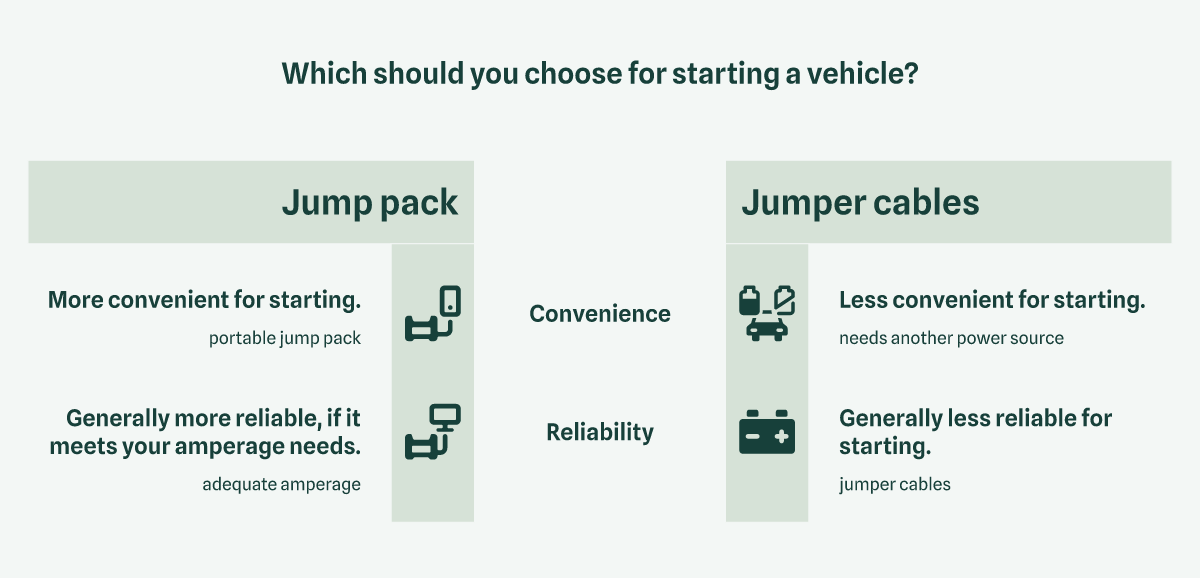
Match the pack to your engine, then buy more margin than you think you need. AutoZone's listings run from the Duralast 800 Amps Portable Battery Jump Starter DL-800 up to the NOCO 6,250 Amps Lithium Jump Starter GB500, so the range is wide. For heavy-duty use, look at high-amperage lithium options. If the battery is completely hammered (below 3 V), a jumper box probably won't start the engine in a cold-start situation, per In The Garage Media. A pack isn't a cure for a failed battery.
What's the best portable jump starter to buy in 2026?
Research current models focusing on lithium-ion technology for best performance and safety features. In The Garage Media notes that "Jump starters can deliver most of their rated amperage even if the battery pack retains a less than 50 percent state of charge, something lead acid batteries can't offer."
Jumper cables were no help at an empty trailhead. Keep them if I buy a jump pack?
If you buy a jump pack, you likely won't need cables for starting, but they might still be useful for other electrical tasks. My pick is to keep a cheap set in the trunk anyway.
Is a jump box better than jumper cables?
Generally, yes, due to convenience and reliability, provided the jump box meets your amperage needs.
FAQ
How much does a jumpbox cost?
Within jumpboxes, price tracks amperage and capacity. The AutoZone lineup runs from the Duralast 800 Amps Portable Battery Jump Starter DL-800 up to the NOCO 6,250 Amps Lithium Jump Starter GB500. I wouldn't chase the biggest number on the box. Match amps to your engine instead, which is the sizing question I cover in 1000 Amp Jump Starter: Enough for Your Vehicle?.
Is a jump box worth it?
Yes, if you drive alone or park where no second car passes. Cables need a helper. The Antigravity article describes the old routine as needing "a set of jumper cables, a secondary power source (like another car), and sufficient room to place the cars close enough to connect the cables." A jumpbox removes the second car and the room it needs. The trade is upkeep. You have to charge it, and lithium packs hold charge well, but a pack left flat for months is just weight in the trunk.
Will a jump box start a dead battery?
Usually, but not always. A lithium pack can push serious current into a weak battery even when its own charge is low. The Antigravity review notes that "jump starters can deliver most of their rated amperage even if the battery pack retains a less than 50 percent state of charge." The exception is a battery that is truly finished. The same source warns that "if the battery is completely hammered (below 3 V), it's likely that in a cold-start situation a jumper box won't be able to start the engine." Below that threshold, replace the battery.
Is a jump box better than jumper cables?
For solo use, yes. A jumpbox carries its own power, so you aren't flagging down strangers. Cables win on cost and on shelf life. They also win on heavy loads, where thick copper simply moves more current than a hand-sized pack. Popular Science notes that "not everyone has enough room for 30 feet of 1-gauge jumper cables that'll safely carry enough current to jump-start a big truck," but that same copper is why heavy-duty cables exist. My pick for a daily driver is a jumpbox plus one set of mid-range cables as backup.
When are jumper cables more useful than a jump pack?
Cables make sense when the pack is flat, when the dead battery sits below 3 V, or when you're jumping something much larger than a car. They draw from a running donor vehicle, so they never need charging and they don't care how long the job takes. A jump pack's safety circuit limits full output to "the 3- to 5-second limit," as the Antigravity review notes. That's fine for a healthy engine but tight for a stubborn one. On a cold morning with repeated cranking, I'd rather have cables and a second car.
Sources
- Antigravity XP 10 battery jump box - Using this compact battery jump system.
- The best jumper cables | Popular Science
- Product Spec Sheet 7979-OM4-B70-03M
- Jump Starter - Portable Car Battery Jump Box | AutoZone
- Jumper & Booster Cables | Clamps, Harnesses, and Pre-Built
- What are the Best Jump Start Booster Cables for Cars? | Batteries Plus
- Should I Get a Portable Jump Starter or Jumper Cables? | Chevy and GMC Duramax Diesel Forum
- Best Jumper Cables 2024 - Jumper Cables for Your Car