Portable Battery Chargers for Cars: What to Keep in the Trunk
Disclosure: BatteryTrail is reader-supported. If you buy through links on this page, we may earn a commission at no extra cost to you. As an Amazon Associate I earn from qualifying purchases.
A portable battery charger for car use is really three different products sold under one vague phrase. You've got chargers that refill a battery over hours, jump starters that dump a burst of current in seconds, and maintainers that trickle charge into a stored battery for weeks. The BLUETTI guide to portable chargers and jump starters draws that line: chargers recharge batteries, jump-start cables deliver immediate starting power, maintainers keep a stored battery topped up over long periods.
If you're searching for a portable battery pack for cars, you probably want a jump starter. I would buy that first.
What actually matters: 3 to 5 specs
Five things are worth checking before you buy. Get them wrong and the unit either won't start your engine or will damage a battery over time.
Peak amps versus your engine size
Peak amps get the biggest font on the box, and they're the number people misread most. Consumer Reports, quoting jump-starter manufacturer Lectron, publishes the clearest thresholds around: small cars with 2.0-liter engines and smaller need at least 800 to 1,200 peak amps, sedans and SUVs with 2.0- to 3.0-liter engines need 1,200 to 2,000, and anything above 3.0 liters needs 2,000 to 3,000. Diesels need more again.
That last part matters if you drive a truck. I would treat the 2,000 to 3,000 amp band as the floor for a big V8, not the ceiling. For a full breakdown of how amp ratings map to engine size, see 1000 Amp Jump Starter: Enough for Your Vehicle?.
Battery voltage and chemistry
Most conventional vehicles run 12V lead-acid batteries, including flooded, AGM, and gel designs, according to BLUETTI. A 12V charger covers most cars, trucks, and SUVs. A 6-volt setting handles some classic vehicles and small equipment, per AutoZone. BestReviews asks the question plainly: is your car battery a 12-volt or a six-volt? Answer that before you buy anything.
Charging current, matched to your battery
Almost nobody checks this spec. BLUETTI's guidance is direct. Check the battery manufacturer's recommended charging current instead of assuming a particular amp rating suits every 70Ah or 100Ah battery. A 15A charger isn't "better" than a 4A charger if your battery maker specifies a lower rate.
Cold-weather performance
Cold is why this category peaks in winter. At 0°F (-18°C), a car battery can lose about 30-40% of its starting power, so you'll need a powerful jump starter, per BLUETTI. A 12-volt car battery and a jump starter's lithium-ion battery both run less efficiently in cold, so if you live somewhere frigid, expect a slight drop in performance on those days, Consumer Reports notes.
Safety certification
UL 2743, the Standard for Portable Power Packs, covers devices that can have a booster function, such as jump-starting a car. Phone-charging battery packs fall under UL 2056 instead. If a listing claims jump-start capability but cites the wrong standard, I would walk away.
Spec table across price tiers
Prices vary by region and retailer, so I've kept this in tiers instead of exact figures. BestReviews notes that portable car battery chargers start under a low entry price, though most quality chargers sit in the mid range, roughly double to five times the cheapest units.
| Tier | What you get | Example products from the sources | Best for |
|---|---|---|---|
| Budget | Basic jump starter or trickle charger, limited features | AstroAI S8 Car Battery Jump Starter 1500A, NOCO GENIUS1 1A 6V/12V Smart Battery Charger, Ring Automotive RSC806 Smart Battery Charger | Occasional use, small engines, maintaining a healthy battery |
| Mid-range | Multi-function jump starter with power bank and light | NOCO Boost Plus GB40, Nexpow 3000A Portable 12V Car Jump Starter, NOCO Fully-Automatic Smart Charger | Daily drivers, family cars, one device for the trunk |
| Premium | Portable charger with smart profiles, or a power station | CTEK CS FREE, NOCO Boost X GBX45, Jackery Explorer 1000 V2 | Multiple vehicles, road trips, off-grid use |
Those are different tools for different jobs, not a ladder from bad to good.
My pick for most trunks is the mid-range jump starter tier. The NOCO Boost Plus GB40 is rated at 1,000A and advertised for gasoline engines up to 6.0 L and diesel engines up to 3.0 L, per BLUETTI. Parkers adds that it's equipped with USB ports and can jump start 6.0-litre petrol and 3.0-litre diesel engines at maximum. That covers a very large share of family vehicles.
Picks by use case
If you just want to restart a dead car
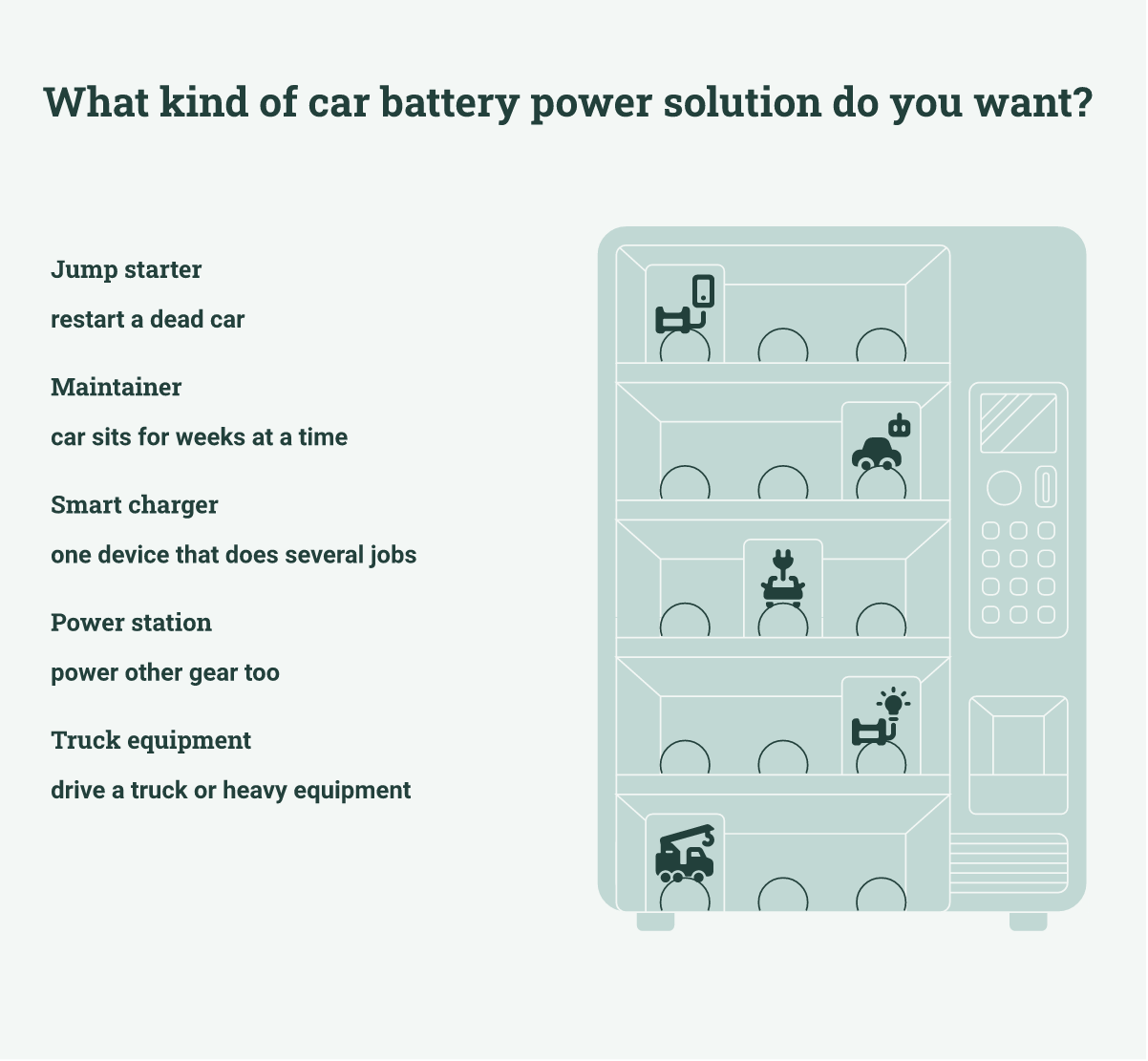
Buy a jump starter. The Nexpow 3000A Portable 12V Car Jump Starter holds up to 20 jumps and doubles as a flashlight and strobe light, according to BestReviews, which named it a top pick. The NOCO Boost Plus GB40 sits in the same role with a smaller footprint.
If your car sits for weeks at a time
You want a maintainer, not a jump starter. Expert Reviews describes the CTEK CS FREE 12V Portable Charger as the best battery charger for versatility, with a 6V and 12V range, 10A maximum current, IP65 rating, and lead-acid, AGM and lithium compatibility. Note one spec carefully: the CS FREE is listed as maintaining yes, jumpstarting no. If you want a car that cranks after a month in the garage, that's the right tool.
If you want one device that does several jobs
The NOCO Fully-Automatic Smart Charger is made for 6-volt and 12-volt batteries. BestReviews calls it a charger, battery maintainer, trickle charger, and battery desulfator all in one, with a thermal sensor that prevents over-charging. That combination is hard to beat for one trunk slot.
If you want to power other gear too
A portable power station is a different product, and it's worth being clear about that. The BLUETTI Elite 30 V2 is a portable power station designed to provide clean, portable power for electronics and appliances. It can't jump-start a vehicle, but its 12V/10A car port can power a compatible DC-input battery charger within the port's ratings to recharge a vehicle battery over time. It weighs 9.48 lbs (4.3 kg) and serves 600W of AC output with 1,500W Lifting Power for supported pure-resistive loads and a 288Wh LiFePO₄ battery.
Parkers makes the same point about the Jackery Explorer 1000 V2: you can use it to plug in a standard battery charger and feed life back into your vehicle. Hook a unit like this up to a solar panel or 12V battery, and you can also use it as a proper trickle battery charger.
If you drive a truck or heavy equipment
The amp math changes depending on what you're starting. Consumer Reports notes that even though electric vehicles don't run on gasoline, they can still need a jump-start because most use the same 12-volt battery as non-EVs to power accessories and boot up the car. Big diesel engines sit at the top of the amp table.
How to use a portable battery pack for car starting
Connect the clamps to the battery terminals, red to positive and black to negative, then start the engine. That's the whole procedure for a jump starter. For a charger, you connect the same way, plug into household power, and let it run for hours instead of minutes. A car battery charger restores and maintains a 12-volt battery using household power, so a drained battery doesn't leave you stranded, per AutoZone.
Check one thing first. Older batteries have a harder time holding onto a charge and drain more easily than new ones, according to BestReviews. If your battery is old, no charger will fix it. That's a replacement job.
What to skip
Skip anything marketed as a jump starter that doesn't list peak amps against engine size. That number is the entire point of the product.
Skip oversized chargers for small batteries. The common advice is to buy the highest amp rating you can afford. I wouldn't do that. BLUETTI's guidance to check the battery manufacturer's recommended charging current exists precisely because more amps isn't automatically better. A charger that pushes current faster than a small battery wants is a liability.
Skip a power station as your only roadside device. The Elite 30 V2 can't jump-start a vehicle, and no power station in this class will. It complements a jump starter.
Skip the cheapest tier if you drive anything larger than a small car. The budget units in the sources are aimed at small engines and maintenance duty.
FAQ
Can you charge a car battery with a portable charger?
Yes, if the device is a charger and not a jump starter. A car battery charger restores and maintains a 12-volt battery using household power, per AutoZone. A 12V charger handles most cars, trucks, and SUVs while a 6-volt setting covers some classic vehicles and small equipment. A jump starter doesn't charge a battery. It delivers a short burst of current to start the engine, and the alternator does the rest.
Will a portable jump starter start a completely dead battery?
Yes, usually, as long as the amp rating matches your engine. Consumer Reports, quoting Lectron, gives these thresholds: small cars with 2.0-liter engines and smaller need at least 800 to 1,200 peak amps, sedans and SUVs with 2.0- to 3.0-liter engines need 1,200 to 2,000 peak amps, and larger engines need 2,000 to 3,000 peak amps. A battery that has internally failed, not just discharged, won't respond to any jump starter.
Do portable jump starters hold up if they just sit in the car for months?
They lose charge over time, and cold speeds that up. Consumer Reports notes that both a 12-volt car battery and a jump-starter's lithium-ion battery are less efficient in colder temperatures. Recharge the unit on a schedule. Check it before winter, not after the first cold morning. A unit that's been sitting since last spring isn't something I would rely on in January.
Why are car chargers either amazing or absolute garbage?
Because the category mixes three different products under one search term. A maintainer, a charger, and a jump starter all address a weak battery, but they function differently, and shoppers often buy the wrong one for their problem. Amp ratings also swing wildly within a single brand, from a 0.8 Amp maintainer to a 250 Amp unit. Match the device to the job and the reviews make far more sense.
When is it OK to unplug a public charger from someone's car and charge your own?
Never, unless the other car has finished charging and the owner has left. Nothing in the research I read supports unplugging an active session, and doing so cuts power to a vehicle you don't own. If you need a charge and every bay is occupied, wait. The etiquette here is simple, and the alternative is someone returning to a car that didn't charge.
Sources
- Guide for Drivers: Portable Car Battery Charger vs. Jump Starter - BLUETTI US
- 5 Best Portable Car Battery Chargers - Oct. 2026 - BestReviews
- The best portable battery chargers tested by experts 2025
- Car Battery Charger - Portable & Trickle Chargers | AutoZone
- Jump-Starter Buying Guide - Consumer Reports
- Best car battery chargers: Avoid a flat battery and time-consuming car trouble | Expert Reviews
- Portable Power Pack Testing | UL Solutions
- Best Portable Car Battery Charger for Road Trips