Tents for Cars: Every Type That Attaches to Your Vehicle
Disclosure: BatteryTrail is reader-supported. If you buy through links on this page, we may earn a commission at no extra cost to you.
A tent for cars is any shelter engineered to attach to a vehicle instead of standing free on the ground. Tents for cars come in four attachment families, and the attachment point is what separates them. You'll find rooftop tents that mount on a roof rack, tailgate and boot awnings that seal to the rear opening, side awnings that run along a roof rack, and ground tents with a vehicle connector. A rooftop tent needs a roof rack, and Thule's guidance says the front-to-back bar spread for rooftop tents must be at least 28 inches or 70cm. A tailgate awning fits by connection height instead, and Vango quotes a vehicle width of 120 to 190 cm for its tailgate awnings. Below I cover every type, how to choose between them, and the safety questions buyers ask most.
What Counts as a Tent for Cars: Definition and the Four Attachment Points
A tent for cars is any shelter engineered to connect to a vehicle, through a roof rack, tailgate, side awning rail or hitch, rather than stand free on the ground.
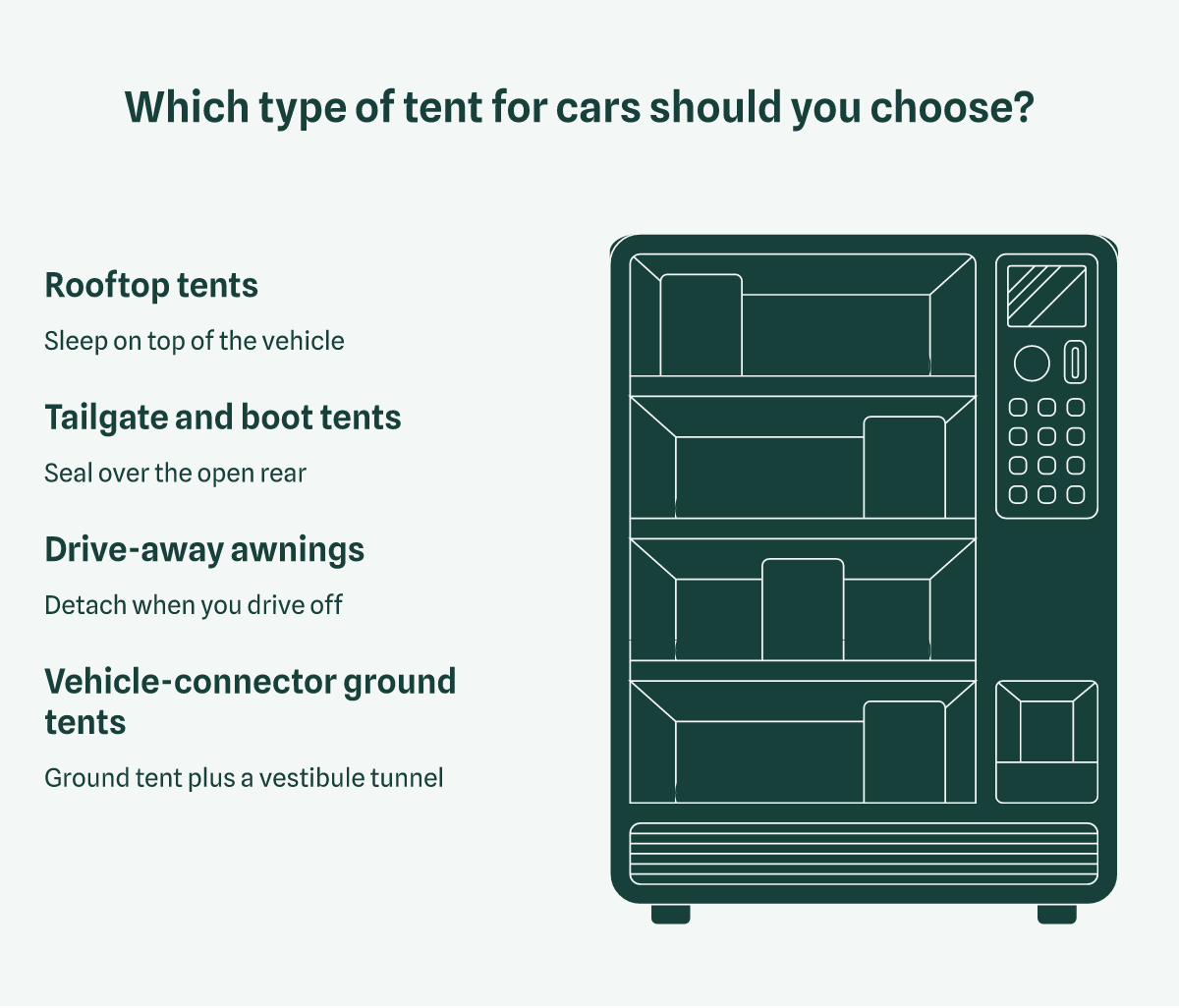
The four attachment families
- Rooftop tents. You sleep on top of the vehicle. They anchor to a roof rack and fold into a compact rectangle about six inches tall, then pop open, usually with the help of gas-powered struts.
- Tailgate and boot tents. Poled or inflatable awnings that seal over the open rear of a hatchback, SUV or van.
- Drive-away awnings. They attach to the side or rear and detach when you drive off, leaving the shelter standing.
- Vehicle-connector ground tents. A standard ground tent plus a vestibule tunnel that links to the car.
How tents for cars actually work
Attachment changes the job the shelter does. The car becomes a structural anchor, a windbreak and a storage extension at once. REI rates its Co-op Base Camp 4 as best for "campers who want a vehicle attachment," and notes that the connector is "spacious enough for four camp chairs and a table."
Setup speed is the other draw. Thule states that most rooftop tents take 1 to 5 minutes to set up, much faster than traditional ground tents.
What to do when attachment won't work
If your car has no roof rack, a tailgate or connector tent solves the same problems without one. Vango quotes a vehicle width of 120 to 190 cm for its tailgate awnings, so measure before assuming a fit.
My take: if you camp in one spot and drive daily, skip the rooftop tent and buy a drive-away awning. Rooftop tents win on speed, not on living space.
Types of Tents That Attach to Cars: Full Comparison Table
Every type below shares one trait: a physical connection to the vehicle, whether that's a roof rack, a tailgate opening, an awning rail or a hitch. That connection changes how the shelter pitches, how it handles wind and where you store your gear.
Rooftop hardshell
A rigid floor and ceiling with canvas or nylon walls, anchored to a roof rack. In transit it folds into a compact rectangle about six inches tall and pops open on gas struts. Pitching takes minutes. It's also the priciest option and the heaviest to lift onto the roof.
Rooftop softshell and car pop-up
Fold-out canvas designs. They cost less than a hardshell and give you more room once open, but there's more fabric to tension so pitching takes longer. If you move camp every morning, that difference matters.
Tailgate and boot tents
Poled or inflatable awnings over the open rear.
Drive-away awnings and side awnings
Budget and connector options
| Type | Attaches to | Fits | Connection height | Approx price | Best for |
|---|---|---|---|---|---|
| Rooftop hardshell | Roof rack | Most roof racks | Bar spread min 70cm | Premium | Fast pitching |
My pick for a first purchase is a tailgate tent over a rooftop hardshell. The common advice says go straight to the roof, but you sleep on the ground with more space for less money.
Rooftop Tents in Detail: Specs, Weights and What Fits Your Car
Rooftop tents are the heaviest and most permanent option in the tents for cars category, so the specs matter more here than anywhere else. The Latitude Pioneer shows what a real listing looks like. Which?
Weight Is Your First Filter
At 54kg, the Latitude Pioneer isn't a one-person lift. Thule have kept the weight down to 58kg "making it easy for two people to get it up on the roof of the tallest car," per The Standard. I would treat anything you can't raise with two people as a permanent installation, not a tent you move between cars.
Rack Spread and Vehicle Width
Thule's rooftop tent guidelines state that "the front-to-back bar spread for rooftop tents must be at least 28" / 70cm." Measure your bars before you buy anything.
Width matters for tailgate and side attachments too. Vango quotes a vehicle width of 120 to 190 cm for its tailgate awnings, so a narrow hatchback and a wide SUV sit at opposite ends of one fitting range. When the usual "it fits most cars" answer doesn't apply, measure your own bar spread and vehicle width and match them to the spec sheet, not to the marketing photo.
Ground Tents With a Car Connection: The Hybrid Middle Ground
A ground tent with a car connection gives you a standalone shelter that also seals to your vehicle when you want the extra room.
The connector is the catch. REI sells the vehicle attachment separately, and it works like a large vestibule rather than a sealed sleeping pod. REI's testers describe it as "spacious enough for four camp chairs and a table." So you get a deep awning plus a car link, and you can leave the connector at home when you pitch the tent on its own. If your car sits far from the tent pad, or your site has no room to park beside it, skip the connector entirely and treat the Base Camp 4 as a plain ground tent.
If you don't need the car link, my pick for the best overall car camping tent is the NEMO Aurora Highrise 4. Outside's testers say it can "comfortably house a family of four" thanks to its 75-inch peak height, steep sidewalls, and two 19.5-square-foot vestibules. Peak height, not floor area, is what makes a four-person tent live like one.
Other ground options worth naming:
- Kelty Wireless 8: 8-person, 83.5-inch peak
- The North Face Wawona 6: 6-person
I would skip the car connector on a short trip. The common advice is to buy the full attachment kit with the tent, but a standalone pitch is faster and the tunnel only earns its keep on multi-night stays.
For rooftop alternatives, see Hardshell Rooftop Tents: Complete Buyer Guide.
FAQ
Is it safer to sleep in your car or a tent?
Neither option is automatically safer, and the deciding factors are ventilation and where you park, not the shelter type. Sleeping inside a closed car carries carbon monoxide and suffocation risk if you run the engine or block airflow, while a tent keeps you out of the driver's seat but offers less protection from weather and wildlife. My rule is simple: never idle a car for heat while you sleep in it. If you want a vehicle attachment, the REI Co-op Base Camp 4 offers one that REI says is spacious enough for four camp chairs and a table.
Are car roof tents worth it?
They are worth it if you camp often and want fast setup, because Thule states most rooftop tents take 1 to 5 minutes to set up, much faster than traditional ground tents. They aren't worth it if you camp twice a year, since you pay a weight and cost penalty for that speed. I would skip a roof tent if your rack doesn't meet that spread.
What is the best car tent to buy?
No single car tent wins for everyone. Your pick depends on whether you sleep on the roof, on the ground, or off the tailgate.
For ground camping, Outside named the NEMO Aurora Highrise 4 its best overall car camping tent after testing 29 tents. It cited easy setup, a roomy interior and excellent ventilation. Want a vehicle attachment instead? REI scores the REI Co-op Base Camp 4 at 90 out of 100 and lists it as best for campers who want a vehicle attachment. For roof sleeping, I would start with a hardshell design and check the Hardshell Rooftop Tents: Complete Buyer Guide.
How safe are car tents?
Car tents are as safe as their anchoring and weather rating. The numbers tell you more than the marketing does. The Latitude Pioneer carries a stated weather resistance of 3,000mm hydrostatic per Which?, which is the figure to compare against your expected rain. Thule requires a front-to-back bar spread of at least 28 inches or 70cm for rooftop tents, so a poorly spread rack is the real risk, not the tent fabric. I would treat the rack rating as the safety limit. Never exceed your vehicle's dynamic roof load while driving.
Roof Tents or Something Else?
Choose a roof tent for speed and a ground tent for space and cost. Choose a tailgate awning if you mainly want shade and a covered boot. Thule states most rooftop tents set up in 1 to 5 minutes, which is the strongest argument for the roof. A ground tent gives you far more floor area for the money, and a tailgate option such as the Kampa Tailnest connects at 160 to 190cm for hatchbacks. If this were my call, I would pick the ground tent unless setup speed genuinely decides your trips.
Sources
- Best roof tents for cars and vans in 2026: reviewed by experts - Which?
- The Best Car Camping Tents of 2026, Tested by Outside
- Best Tents for Camping of 2026: Tested | REI Expert Advice
- Best car awnings: tents that attach to cars – UK Edition
- Thule Rooftop Tent Guidelines
- Best car tents 2025: compact rooftop designs for next-level camping | The Standard
- The complete guide to rooftop tents by Thule | Thule | United States
- What To Know About Car and SUV Tents