Hardshell vs Softshell Rooftop Tents
Disclosure: BatteryTrail is reader-supported. If you buy through links on this page, we may earn a commission at no extra cost to you.
Buy a hardshell if you camp often or cover long highway miles. Buy a soft shell rooftop tent if sleeping space per dollar is the priority. That's the whole decision, and everything else is detail.
The gap is real in both directions. A hardshell opens in 30 to 60 seconds and sits lower on the roof. Neither type wins outright, and the specs below show where each one pulls ahead. I compare the two on setup time, weight, roof load, sleeping capacity and cost, then flag the cases where the cheaper tent is the better buy.
One-Paragraph Verdict: Which Rooftop Tent Type Actually Wins
Buy a hardshell if you camp often or cover long highway miles. Buy a soft shell rooftop tent if sleeping space per dollar is the priority. That's the whole decision, and everything else is detail.
The hardshell case rests on speed and weather. Hardshells win on setup speed (30 to 90 seconds) and aerodynamics at highway speeds, per Everlead Outdoor. A folded hardshell often sits just 6 to 8 inches tall, so it creates minimal drag and wind noise according to Rooftop Tent Lab. A softshell needs 3 to 10 minutes once you factor in the rain fly and poles, and the taller closed profile contributes to the commonly reported 10 to 25 percent highway fuel economy drop.
The softshell case rests on room and money. Outdoor Gear Lab notes quality softshells typically cost half as much as hardshell models while delivering the same core benefits: a thick mattress, weather protection, and elevation off cold, uneven ground. The price gap is convenience, not comfort.
My take goes against the usual forum advice to just buy once and cry once. I would skip the premium hardshell unless you're actually touring, because a weekend camper pays for setup speed they use twice a month. If your trips are occasional, put the savings into a quality softshell and better bedding. If you camp weekly, the hardshell wins on the morning you're packing up in rain.
Side-by-Side Spec and Cost Table
| Spec | Soft shell | Hardshell |
|---|---|---|
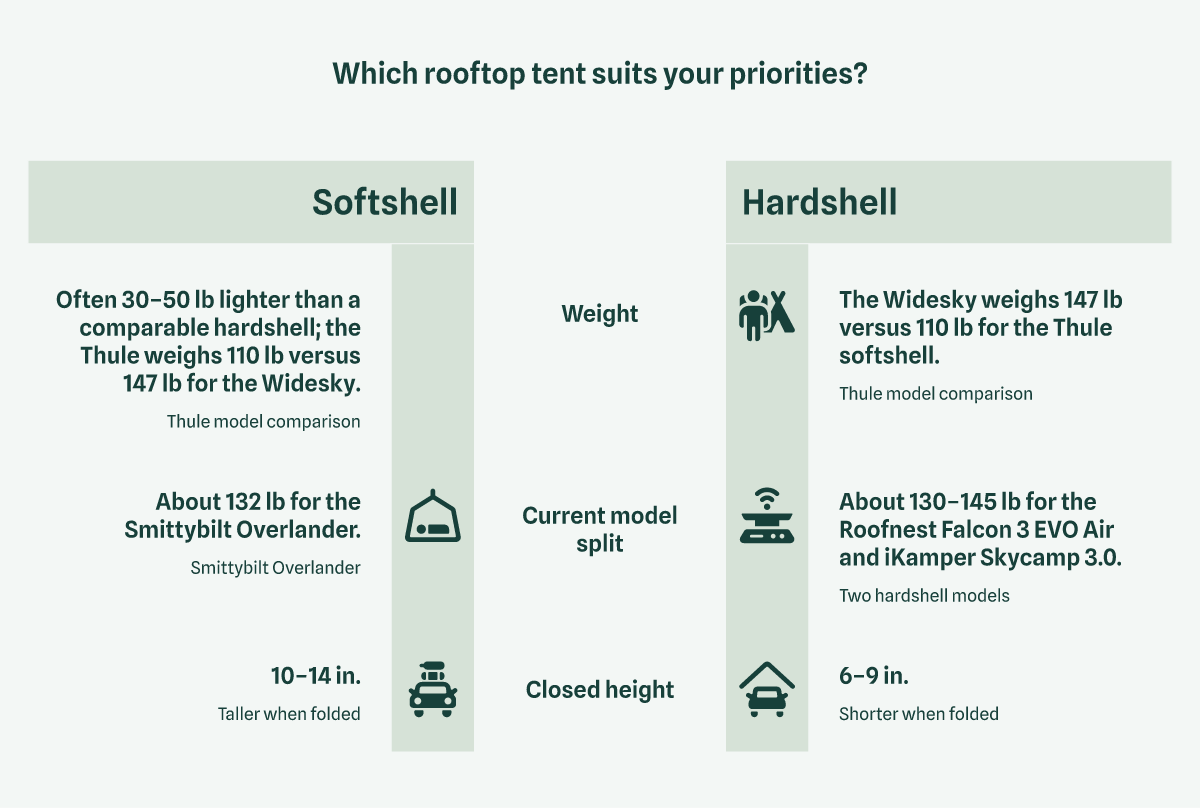
| Weight | Often 30–50 lb lighter than a comparable hardshell | Thule Approach 2S 110 lb vs Widesky 147 lb |
| Current model split | About 132 lb (Smittybilt Overlander) | About 130–145 lb (Roofnest Falcon 3 EVO Air, iKamper Skycamp 3.0) |
| Closed height | 10–14 in | 6–9 in |
Price
Weight
The Outside Online comparison found softshells "often 30 to 50 pounds lighter than a hardshell of comparable size." The two Thule tents make that concrete: the soft-shell weighs 110 pounds, the hardshell 147. But 2026 models bracket the split tightly. Roofnest lists the Falcon 3 EVO Air clamshell at about 130 lb, iKamper the Skycamp 3.0 at about 145 lb, and the Smittybilt Overlander softshell at about 132 lb, per rooftoptentlab. My read: the old weight rule is now a per-model question, so weigh your shortlist individually.
Closed height, floor and capacity
A folded softshell sits 10–14 inches tall closed versus 6–9 inches for a hardshell, per rooftoptentlab. Softshells pack into a smaller travel footprint on the rack, which matters on compact vehicles. Floor space favors softshells: the Smittybilt gives 35.1 sq. Ft. And the Thule Approach Medium 33.6 sq. Ft. For 2+, per Switchback Travel.
When a Soft Shell Rooftop Tent Wins
Let me plan the points concisely.
Subheadings:
Sleeping space per dollar
Small cars and lighter mounting
Occasional weekends and budget picks
Fold-out livability and mounting hardware
Let me draft, counting words.
Draft:
When a Soft Shell Rooftop Tent Wins
Sleeping space per dollar
A soft shell rooftop tent is the better buy when you need beds, not speed. Outdoor Gear Lab puts the same trade in blunter terms: softshells "typically cost half as much as hardshell models while delivering the exact same core benefits." That gap buys convenience, not comfort. If floor area for a family or a dog is your priority, take the softshell.
The full quote is worth reading: "Quality softshells typically cost half as much as hardshell models while delivering the exact same core benefits: a thick mattress, bombproof weather protection, and elevation off cold, uneven ground."
Small vehicles and easier mounting
The compact closed footprint fits better on smaller cars and trucks. Softshells are also often 30 to 50 pounds lighter than a hardshell of comparable size, per Outside Online, so a two-person lift onto the rack is realistic.
Weekends only, and budget picks
Livability and mounting
If you want a fold-out with real livability, the ROAM Vagabond 2.0 and Vagabond XL 2.0 pair a 2.5 in. Dual-layer memory foam mattress with LED lighting and an insulated base. Mounting a softshell on a platform rack means budgeting for a hardware kit, such as the Eezi-Awn Roof Top Tent DIY Installation Kit or the Inspired Overland Rooftop Tent Hardware Kit. Shipping weights run from about 115 lb for the TMBK to about 175 lb for the Bushveld 4, so line up two people, or a forklift for the heavier tents, before delivery.
I would skip the hardshell upgrade if you camp a handful of weekends a year.
Also need link? Internal links allowed: Hardshell guide and Tents for Cars. Could add one naturally, e.g., "Tents for Cars: Every Type That Attaches to Your Vehicle", but keep within word limit. Maybe add one link to hardshell guide. It's "When a soft shell wins" so maybe link to hardshell buyer guide as the other side. Actually careful: scope says leave hardshell wins alone. A link is fine but maybe skip to save words. I'll include one link plausibly.
Let me count words carefully.
Para 1 heading: "## When a Soft Shell Rooftop Tent Wins" (counts as heading)
Sleeping space per dollar
"A soft shell rooftop tent is the better buy when you need beds, not speed. Outdoor Gear Lab describes the gap as convenience rather than comfort: quality softshells "typically cost half as much as hardshell models while delivering the exact same core benefits." If your priority is floor area for a family or a dog, the fold-out wins."
S2: ~20. S3: ~30. S4: ~16. Hmm that's a lot. Total budget 320. Let me trim.
Let me write tighter.
Draft final:
When a Soft Shell Rooftop Tent Wins
Sleeping space per dollar
A soft shell rooftop tent wins when you need beds, not speed. Outdoor Gear Lab calls the difference convenience rather than sleeping comfort, saying quality softshells "typically
When a Hardshell Rooftop Tent Wins
I recommend a hardshell rooftop tent when setup speed and long term maintenance are top priorities. A clamshell design, such as the Roofnest Falcon 3 EVO Air, opens in about 30 seconds, requiring only the release of two latches and the action of gas struts, which contrasts with the 3 to 10 minutes a fold-out softshell requires once you account for the rain fly and poles.
Durability and Driving Efficiency
Hardshell designs resist weather better and last longer. The waterproof shell handles storms and ages well, while softshell ripstop covers need more frequent cleaning for mildew. Driving economics favor hardshells too. Their low profile, often just 6 to 8 inches tall when closed, creates minimal drag and wind noise. That matters because owners commonly report a 10 to 25% drop in highway fuel economy with a rooftop tent mounted, which gets worse with the taller softshell profile.
Practicality and Gear Management
I think integrated features make hardshells the better call for frequent campers. Many units come with exterior crossbars, so you don't lose rooftop carrying capacity. I haven't found a softshell that supports these bars. You also skip the chore of ground clearing and stowing a separate travel cover, which saves the 20 minutes of clearing rocks and sticks before pitching.
Considering Weight
If weight worries you, look at specific models like the Roofnest Falcon 3 EVO Air. It's cited as being about 130 pounds, making it one of the lighter hardshell options mentioned.
FAQ
Are soft shell roof top tents any good?
Yes, for the money they're the best value in rooftop camping. Outdoor Gear Lab reports that "quality softshells typically cost half as much as hardshell models while delivering the exact same core benefits: a thick mattress, bombproof weather protection, and elevation off cold, uneven ground." The trade-offs are real. Setup and teardown take 5 to 10 minutes, and the zippered travel cover ages worse than a hard shell. I would still buy one if you camp a few weekends a season and want the most sleeping space per dollar.
What is the best softshell rooftop tent?
Switchback Travel names the Thule Approach its Best Softshell Rooftop Tent, and the Approach Medium is listed at 128 lb with a 33.6 sq. Ft. Floor and 2, 2+, and 3+ capacities. That weight is the lightest softshell in its comparison table. The Smittybilt Gen2 Overlander is the budget pick at 154 lb with a 35.1 sq. Ft. Floor, and Switchback calls it "our favorite budget rooftop tent." My pick between them is the Thule Approach if your rack capacity is tight, and the Smittybilt if floor area matters more.
What is the cheapest hardshell rooftop tent?
The cheapest hardshell in the Switchback Travel table is the Thule Widesky at 147 lb with a 30 sq. Ft. Floor, and it's the only hardshell there that undercuts the priciest softshells. If your budget is the hard limit, I wouldn't stretch for a hardshell. You get sleeping space for less with a softshell, and that's the honest trade.
Is there a hard shell rooftop tent with bottom access?
No mainstream hardshell in the sources I checked offers bottom access, and I wouldn't expect one. Hardshells open from the top. As rooftoptentlab describes it, a clamshell "pops open in about 30 seconds: release two latches and gas struts do the rest." Softshells unfold over the side on a ladder, which is closer to what people mean by bottom access. If climbing through a hatch or ladder opening matters most, look at a fold-out design instead.
Is there truly ANY benefit to having hard shell vs soft shell tent? I can't imagine paying an extra $2k just for a plastic cover.?
Yes, and the gap is bigger than the cover. Everlead Outdoor reports hard shells win on "setup speed (30-90 seconds), aerodynamics at highway speeds, all-weather durability, and long-term maintenance cost." A softshell sits 10 to 14 inches tall closed versus 6 to 9 inches for a hardshell, and owners commonly report a 10 to 25% drop in highway fuel economy with a rooftop tent mounted. Camp twice a year? I would skip the hardshell. The common advice to always buy hard shell ignores how little you use it.
Sources
- Hardshell vs. Soft-shell Rooftop Tents: Which Is Right For You?
- Best Rooftop Tents | Switchback Tested
- Roof top tent test – 12 ½ roof tents in direct comparison | ENDURO Mountainbike Magazine
- Rooftop Tent Guide: Hard vs Soft Shell, Racks | NVMOS
- Soft Shell vs Hard Shell Rooftop Tent: Which Should You Buy in 2026?
- The Best Rooftop Tents | Tested & Ranked - Outdoor Gear Lab
- Hard Shell Vs Soft Shell Roof Top Tent: Clear Verdict
- Hard Shell vs Soft Shell Roof Top Tents: 2026 Comparison - Rack Attack